

Finally, brothers and sisters, farewell. Be restored; listen to my appeal; agree with one another; live in peace; and the God of love and peace will be with you.
2 Corinthians 13:11
I wonder if you, dear reader, have phrases you use when departing the company of another. After a visit, do you say goodbye with words such as, “It was so good to see you and catch up. Thanks so much for coming by”? Maybe there’s a second goodbye in the driveway, with additional words like, “Be careful as you travel home. Text us to let us know you arrived safely”. We experience this at the end of worship, too, when a pastor offers a benediction—sending the congregation out with words of blessing.
Paul does this throughout his letters in the New Testament, and the passage above comes from the Epistle lesson for the last Sunday of this month, which is also Peace with Justice Sunday. His words of blessing to the people of Corinth are heartfelt and echo the themes woven throughout his letter. He longs for their restoration, urges them to listen, and calls them to agreement and peace. These are timeless words for us today, especially in a world marked by disruption, unrest, violence, and war.
Jackie and I were fortunate to travel by air last month—which might give you pause, given recent delays, longer TSA lines, and higher ticket prices. I say fortunate because someone else was doing the driving, freeing me to grab a book and read while watching the departure board announce yet another delay.
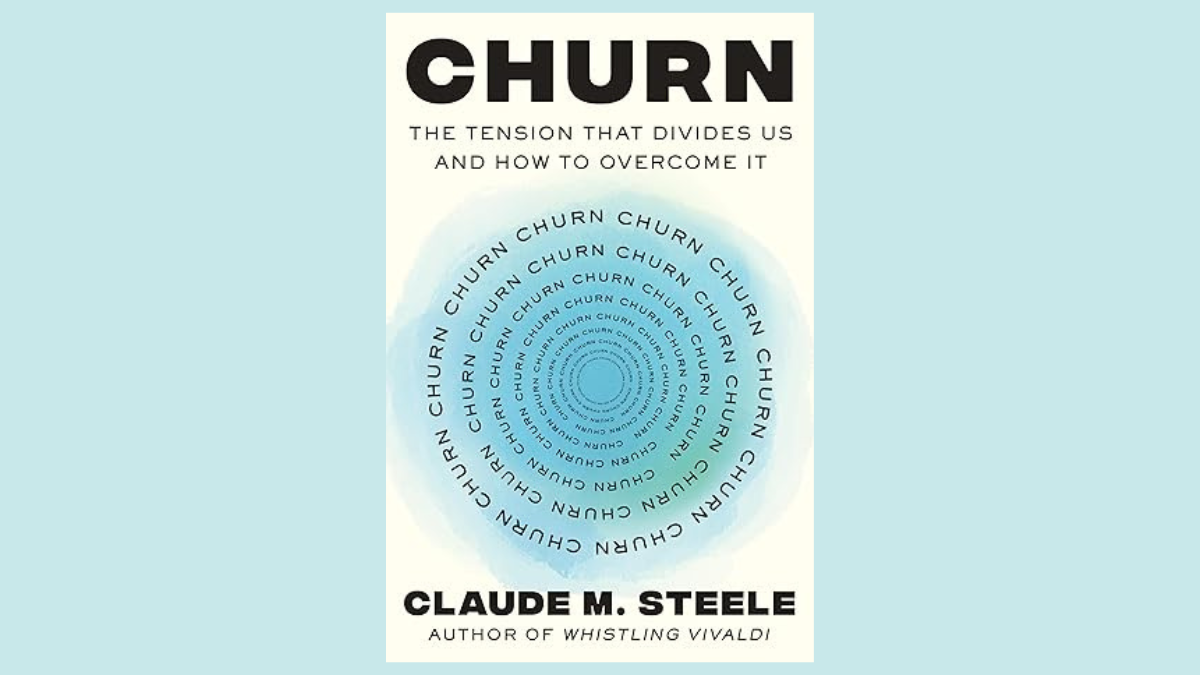
The above book’s unique title caught my eye in an airport Hudson store, and its subtitle resonated immediately. It named a tension many are feeling across our communities—a churn that fuels disharmony, deepens distrust, and widens divisions. Everyone seems to have an opinion about why it’s happening, and finding a resource that might offer practical strategies felt like a worthwhile investment.
As the author, Dr. Claude M. Steele explains, Churn “focuses less on the nature or politics of identity and more on what it takes to build trust between people of different identities—even oppositional identities—in the real-life settings of our lives” (p. 2). That was enough to hold my attention, and 179 pages later, I can recommend it as a meaningful read.
One compelling example comes from Georgia State University, which invested heavily in data analytics to better support students. The remarkable result was not just improved metrics, but a renewed emphasis on relationships. Faculty and staff took time to connect with students— encouraging and resourcing them so that academic success became a reality rather than just a dream.
Near the end of the book, the author offers a simple yet powerful framework for building trust: seeing, welcoming, and supporting. I found myself thinking, this is what thriving churches do so well.
Seeing someone is to recognize them for who they are and where they are—and to celebrate them as they are. “I see you” is an affirming word for every person we encounter and a phrase worth adding to our daily vocabulary.
Welcoming has long been the hallmark of great leaders in hospitality. Jesus surpasses them all. Long before Hilton or Marriott, he welcomed everyone. We can grow as people of radical hospitality, creating spaces where others feel genuinely received. Yet true welcome also includes curiosity—the desire to know someone more deeply. When someone welcomes me with curiosity, I find myself lingering longer, opening up, and discovering shared meaning through our stories.
Supporting goes beyond offering answers or resources. It is, as the author writes, “helping each other realize their goals” (p. 178). It is in this space that deeper relationships are formed. Supporting one another becomes a powerful way to build trust—reducing churn and division while strengthening community and harmony.
To live in peace is not accidental or automatic. To live in peace takes an intentional effort on our part to build relationships. Maybe we could consider Dr. Steele’s strategy to see, welcome and support in our efforts to live in peace. Maybe when we commit to seeing one another with dignity, welcoming one another with genuine curiosity, and supporting one another in meaningful ways, we begin to live out the very restoration Paul envisions. In a world marked by division and churn, perhaps these simple yet profound practices become the pathway toward trust, community, and the peace of God that always goes with us as we strive to be disciples of Jesus Christ.
Blessings, 
David